

Anti-Claudin 6 Antibody Drug Conjugate Benefits Patients with Advanced Platinum-Resistant Ovarian Cancer with Low Toxicity
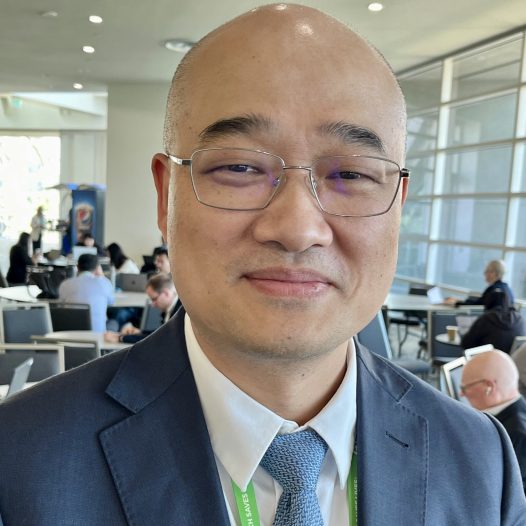
An interview with: Tao Zhu, MD, Chief Physician and Vice President, Zhejiang Cancer Hospital, China
SAN DIEGO, USA— The investigational drug QLS5132 had “remarkable anti-tumor activity” in patients with late-stage platinum resistant ovarian cancer, according to data reported at the American Association of Cancer Research 2026 Annual Meeting.
The drug is an antibody drug conjugate targeting the transmembrane protein claudin 6, which has almost no expression in healthy tissue, but is expressed in some cancer tissues, including ovarian cancer.
Tao Zhu MD, chief physician and vice president of Zhejiang Cancer Hospital in China told the AACR about the encouraging response rates they noted among 28 patients with ovarian cancer, with manageable toxicities. He gave more details to our reporter, Peter Goodwin:
AUDIO JOURNAL OF ONCOLOGY: Tao Zhu MD
IN: [GOODWIN]”I am at the AACR Meeting …
OUT: ….for the Audio Journal of Oncology 4:49
AACR 2026 ABSTRACT:
Presentation CT037:
Publishing Title:
A first-in-human phase 1 trial of a novel claudin 6 (CLDN6)-targeting antibody drug conjugate (ADC) QLS5132 in patients (pts) with platinum-resistant ovarian cancer (PROC)
Author Block:
Y. Xiang1, Z. Song2, J. Li3, L. Chen3, Y. Sun4, D. Zou5, Y. Li5, S. Zhang6, Y. Ding6, Y. Gu1, X. Liu7, T. Zhang7, X. Kang7, W. Tao7, T. Zhu2;
Hall H – Ground Level – Convention Center
1Peking Union Medical College Hospital, Beijing, China,
2Zhejiang Cancer Hospital, Hangzhou, China,
3Cancer Hospital of Shandong First Medical University (Shandong
Cancer Institute, Shandong Cancer Hospital), Jinan, China,
4Fujian Cancer Hospital, Fuzhou, China,
5Chongqing University Cancer Hospital, Chongqing, China,
6The First Hospital of Jilin University, Changchun, China,
7Qilu Pharmaceutical Co., Ltd., Jinan, China
Abstract Body:
Background: QLS5132 is a highly selective ADC composed of a humanized anti-CLDN6 hIgG1 antibody and a novel topoisomerase-1 inhibitor as cytotoxic payload via a hydrophilic cleavable linker LK1b, with a drug-to-antibody ratio of 8. QLS5132 showed an expanded therapeutic window and potent antitumor activity in PROC in preclinical studies.
Methods: The trial (NCT06932094) recruited pts with histologically or cytologically confirmed advanced PROC, who failed or had no standard therapy. Accelerated titration design and Bayesian optimal interval design were adopted in dose-escalation stage. QLS5132 was administered via intravenous infusion once Q3W at dose levels of 1.6 mg/kg, 3.2 mg/kg, 4.8 mg/kg, 5.6 mg/kg, and 6.4 mg/kg. Two dose levels would be selected in dose-expansion phase. The primary endpoints were safety.
Results:
As of Jan 21, 2026, 28 pts with advanced PROC were enrolled (ovarian cancers:26 pts, fallopian tube cancers:2 pts). The dose-escalation for the 6.4 mg/kg cohort was completed. Median age was 57.5 years. Ten (35.7%) pts received ≥5 lines of prior treatment, 25 (89.3%) pts received prior bevacizumab, and 22 (78.6%) pts received prior polyADP ribose polymerase inhibitors. Dose-limiting toxicity of grade 4 platelet count decreased occurred in one patient at 6.4 mg/kg dose level. Twenty-six (92.9%) pts experienced TEAEs (treatment-related, 92.9%). The most common TRAEs of any grade with incidence >50% were nausea (85.7%), anorexia (60.7%), anemia (53.6%), and weakness (53.6%). Alopecia, bone pain, back pain, hypoesthesia, and mucositis oral occurred in one (3.6%) patient, respectively. No interstitial lung disease, ocular toxicity, or febrile neutropenia occurred. Most gastrointestinal TRAEs were grade 1 or 2. Nine (32.1%) pts experienced grade ≥3 TRAEs. The hematological TRAEs of grade ≥3 occurred in 2 (66.7%) pts at 6.4 mg/kg dose level, and 5 (20.0%) pts at <6.4 mg/kg dose level. TRSAEs occurred in one (3.6%) patient at 6.4 mg/kg dose level, which were hematologic toxicities. There were no TRAEs leading to treatment discontinuation or death. Nine pts achieved PR (2 in 3.2 mg/kg, 5 in 4.8 mg/kg, and 2 in 6.4 mg/kg dose level), including 2 pts with undetected CLDN6 expression. In 18 efficacy-evaluable pts across all dose levels, the ORR and DCR were 50.0% and 94.4%, respectively. In 17 efficacy-evaluable pts at ≥3.2 mg/kg dose levels, the ORR and DCR were 52.9% and 100%, respectively. QLS5132 showed response regardless of baseline CLDN6 expression. After multiple administrations, the CA125 levels in most pts showed a decreasing trend compared with baseline.
Conclusions:
QLS5132 was well-tolerated under potential recommended dose levels (<6.4 mg/kg) and presented remarkable antitumor activity in pts with advanced PROC. Patients enrollment for PROC, non-small cell lung cancer, gastric cancer, and other cancers are ongoing.
PRESS RELEASE
New Antibody-drug Conjugate Shows Clinical Benefit for Advanced Platinum-resistant Ovarian Cancer
The investigational drug led to objective response and disease control in patients with late-stage disease
SAN DIEGO – Patients with advanced platinum-resistant ovarian cancer whose disease had progressed on standard therapy experienced clinical benefit when treated with the investigational antibody-drug conjugate (ADC) QLS5132, according to results from a phase I clinical trial presented at the American Association for Cancer Research (AACR) Annual Meeting 2026, held April 17-22.
Patients diagnosed with platinum-resistant ovarian cancer face both a poor prognosis and limited treatment options, explained Tao Zhu, MD, chief physician and vice president of Zhejiang Cancer Hospital in China, who presented the study.
Zhu and collaborators tested an investigational ADC, QLS5132, which targets the protein CLDN6. QLS5132 combines a CLDN6-targeting monoclonal antibody with a cytotoxic payload, topoisomerase-1 inhibitor, at a drug-to-antibody ratio of 8:1. CLDN6, Zhu said, makes an ideal target as a protein with very high expression on the surface of ovarian cancer cells and minimal cell-surface expression in healthy tissues.
“The primary purpose of this first-in-human study was to evaluate the safety, tolerability, and pharmacokinetic profile of QLS5132 in patients with platinum-resistant ovarian cancer and determine the recommended phase II dose for future clinical development,” Zhu said. “Additionally, we aimed to assess preliminary antitumor activity to establish an early signal of clinical benefit in this heavily pretreated population with limited options.”
The phase I, single-arm, dose-escalation trial enrolled 28 patients with a median age of 57.5 who had been diagnosed with advanced platinum-resistant ovarian cancer and who had experienced progression while on standard therapy. The research team administered QLS5132 as an intravenous infusion every three weeks at dose levels of 1.6 mg/kg, 3.2 mg/kg, 4.8 mg/kg, 5.6 mg/kg, and 6.4 mg/kg.
Treatment-related adverse events (TRAEs) occurred in 26 (92.9%) patients, with nausea, anorexia, anemia, and weakness occurring most frequently. Nine (32.1%) patients experienced TRAEs of grade 3 or higher, and of those grade ≥3 TRAEs, seven were instances of hematological toxicity. No TRAEs led to treatment discontinuation or death, and no patients experienced interstitial lung disease, ocular toxicity, or febrile neutropenia, Zhu said.
After a median follow-up of 2.2 months, nine patients had a partial response at various dose levels. Two of these partial responses occurred in patients who had no detectable CLDN6 expression.
Across all dose levels, 18 evaluable patients experienced an objective response rate of 50% and a disease control rate of 94.4%. When calculated for the 17 evaluable patients who had received dose levels ≥3.2 mg/kg, the objective response rate and disease control rate rose to 52.9% and 100%, respectively. These responses to QLS5132 occurred irrespective of patients’ CLDN6 expression levels at baseline.
“The most encouraging finding from our study was that QLS5132 demonstrated compelling antitumor activity in patients with platinum-resistant ovarian cancer, with an objective response rate exceeding 50%,” said Zhu. “Equally important, at the potential recommended phase II dose, we observed a favorable safety profile with no reported cases of interstitial lung disease, ocular toxicity, oral mucositis, or febrile neutropenia.”
Zhu also noted that, though more research would be needed to confirm, preliminary data indicated antitumor activity from QLS5132 regardless of CLDN6 expression levels—which, he said, could expand its potential as a treatment option to a broad cohort of patients with platinum-resistant ovarian cancer.
Zhu acknowledged that further research would be needed to fully understand why QLS5132 can have anticancer effects in patients with undetectable CLDN6 tumoral expression. But he suggested the phenomenon may have a few explanations, including tumor heterogeneity, as well as a potent bystander effect resulting in antitumor efficacy even in cells with low or no CLDN6 expression.
“These findings support the advancement of QLS5132 into phase III studies, with the goal of providing a much-needed new treatment option for these patients,” said Zhu.
Limitations of this study include a small sample size and an exploratory single-arm design.
Tao Zhu MD, AACR 2026 Audio Journal of Oncology TEXT
April 28, 2026